
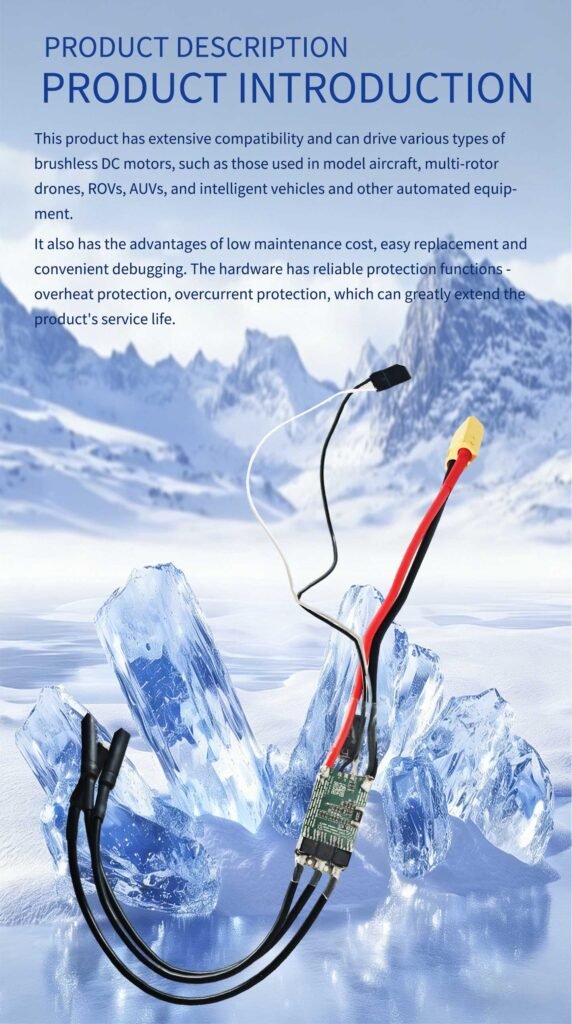
n the power system of unmanned vessels, the brushless electronic speed controller (ESC) serves as the “power center” that connects the battery and the brushless motor. It not only efficiently converts direct current into three-phase alternating current to drive the motor, but also directly affects the power response, endurance, and operational stability of the unmanned vessel. Especially in water operation scenarios, factors such as salt fog, humidity, and wave impacts impose higher requirements on the reliability and protection of the ESC. Therefore, precise selection is the key to ensuring the efficient and safe operation of unmanned vessels.
I. Core Performance Parameters: “Hard Indicators” for Selection
1. Rated Current and Peak Current
The rated current of the electronic speed controller is the maximum current value for its continuous stable operation, while the peak current is the maximum current that can be endured within a short period of time. These two parameters directly determine whether the electronic speed controller can meet the power requirements of the unmanned ship motor. During the selection process, it is necessary to ensure that the rated current of the electronic speed controller is greater than the maximum working current of the motor, and the peak current can cover the instantaneous large current during the motor’s startup and acceleration, avoiding the burnout of the electronic speed controller due to overload. For example, if the maximum working current of the unmanned ship motor is 25A, it is recommended to choose an electronic speed controller with a rated current of 30A and a peak current of 40A or above, such as this model from Yu Hai Yun Zhou. The rated current is 30A and the peak current is 40A, which can fully meet the power requirements of small and medium-sized unmanned ship motors, while leaving sufficient safety margin.
2. Input Voltage Range
The input voltage of the electronic speed controller needs to be completely matched with the battery pack of the unmanned ship; otherwise, it will cause the electronic speed controller to fail to work or even be damaged. Currently, the commonly used lithium battery packs for unmanned ships include 3S, 4S, 6S, etc., with corresponding voltages of 11.1V, 14.8V, 22.2V, etc. During the selection process, it is necessary to confirm that the voltage range supported by the electronic speed controller covers the voltage of the battery pack. Yu Hai Yun Zhou electronic speed controllers support 3-6S lithium battery packs (DC12-25.2V), which can be compatible with the vast majority of small and medium-sized unmanned ship battery configurations, and can be seamlessly integrated without additional modification.
3. Energy Conversion Efficiency
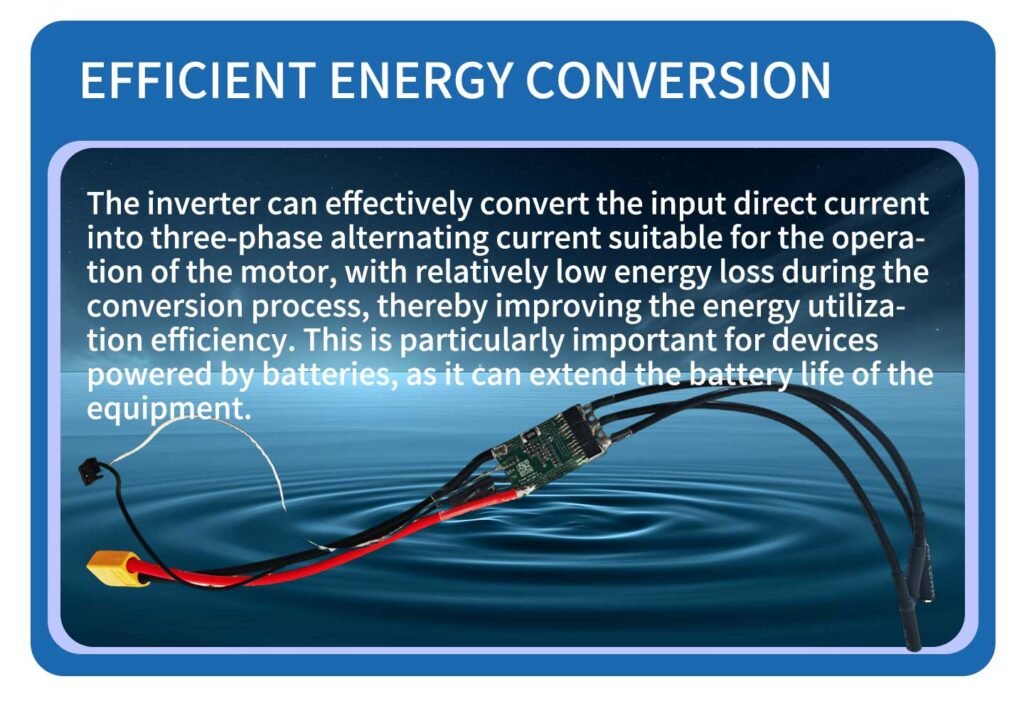
The energy conversion efficiency of the electronic speed controller directly affects the endurance of the unmanned ship. The higher the efficiency, the higher the utilization rate of the battery energy. High-quality electronic speed controllers can achieve an efficiency of over 90%, effectively reducing energy loss and prolonging the single operation time of the unmanned ship. Yu Hai Yun Zhou electronic speed controllers have optimized circuit design to achieve efficient DC – three-phase AC conversion, with extremely low energy loss. For unmanned ships that rely on battery power, it can significantly improve the endurance performance and reduce the frequency of return charging.
4. Control Mode and Compatibility
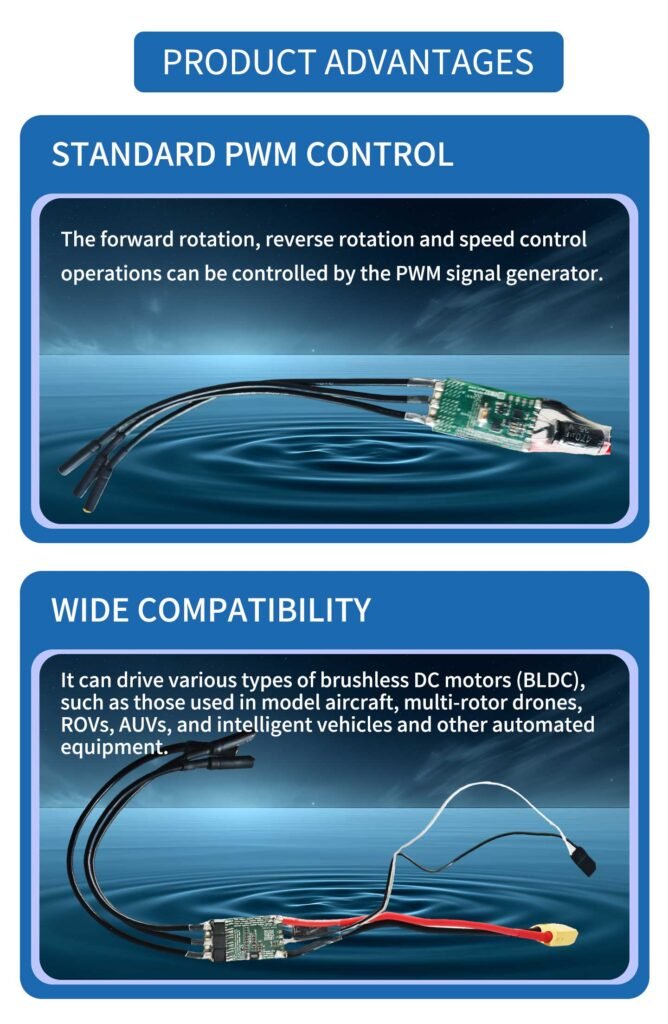
The electronic speed controller of the unmanned ship needs to be compatible with the flight controller, remote controller, and other control systems. The mainstream control methods include PWM control, CAN bus control, etc. Among them, PWM control is convenient for debugging and has strong compatibility, and is the preferred choice for small and medium-sized unmanned ships. Yu Hai Yun Zhou electronic speed controllers support standard PWM control. They can precisely control the motor to rotate forward, reverse, and adjust speed through PWM signal generators, and are compatible with mainstream unmanned ship flight controllers such as Pixhawk, which can be plugged in and used directly, with low debugging difficulty, significantly reducing the integration cost of the unmanned ship.
High-quality electronic speed controllers should adopt fully sealed waterproof design, with a protection level of at least IP65 or even higher for some high-end models, and support short-term immersion operation. Weihai Yunzhou electronic speed controllers use re-sealing or epoxy resin waterproof treatment, which can effectively resist erosion from seawater and rain. Even in the high-salt spray coastal environment, they can work stably for a long time, avoiding faults caused by water ingress and corrosion.
2. Heat dissipation and anti-vibration capability
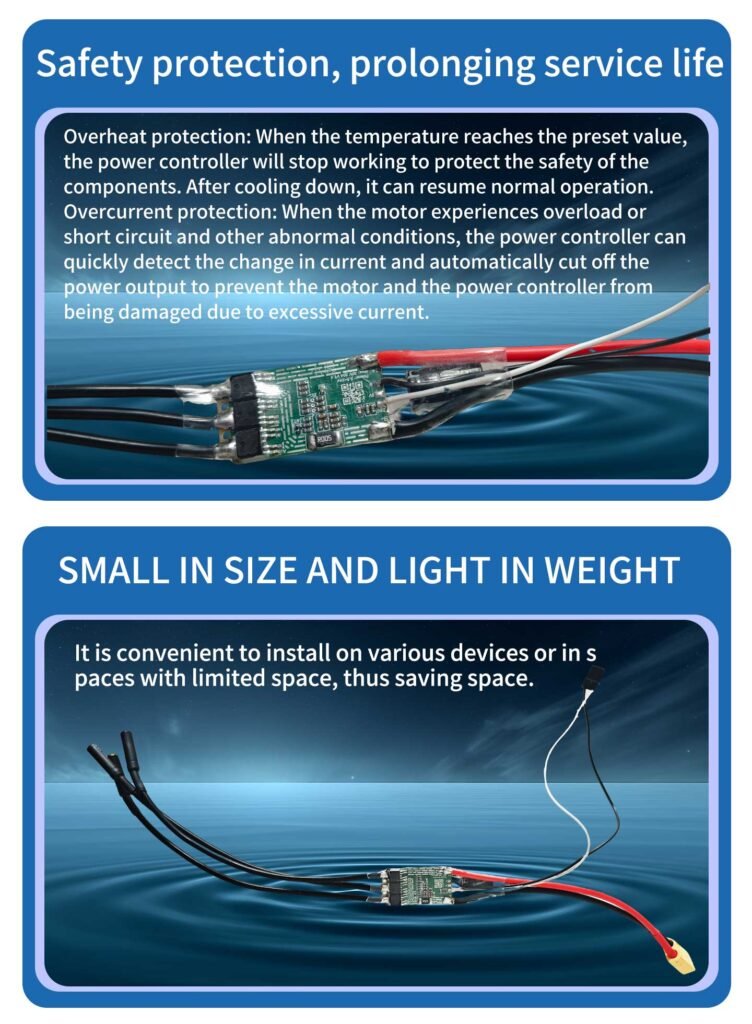
When the unmanned ship motor operates at high speed, it generates a large amount of heat. The electronic speed controller needs to have good heat dissipation performance to prevent overheating from triggering protection or even burning out. At the same time, the unmanned ship will be subjected to wave impact during navigation, causing severe vibrations. The anti-vibration capability of the electronic speed controller directly affects its service life. Weihai Yunzhou electronic speed controllers have an overheat protection mechanism. When the temperature reaches the preset threshold, it automatically stops working, cools down, and returns to normal. At the same time, it adopts a compact design, with a stable structure, and can adapt to the bumps and impacts during the unmanned ship’s navigation, ensuring the stability of the power system.
3. Volume and weight
The unmanned ship has a high requirement for lightweight. The volume and weight of the electronic speed controller will directly affect the balance of the ship body and its navigation performance. When selecting, it is necessary to choose an electronic speed controller with a smaller volume and lighter weight while meeting the performance requirements. Weihai Yunzhou electronic speed controllers weigh only 9 grams and have a compact size. They can be easily installed in the narrow space of the unmanned ship without adding extra burden to the ship body, and will not affect the flexibility of the unmanned ship’s navigation.
III. Safety Protection Function: The “Safety Barrier” of the Unmanned Boat
1. Multiple Protection Mechanisms
High-quality electronic controllers must have comprehensive protection functions, including overcurrent protection, overheat protection, overvoltage protection, short-circuit protection, etc. These functions can automatically cut off the power supply in abnormal conditions to prevent damage to the motor, electronic controller, and battery. For example, when the motor experiences overload or short circuit, the electronic controller can quickly detect the current change and cut off the output; when the temperature is too high, it automatically stops working to cool down, ensuring the safety of the equipment. The electronic controller of Weihai Yunzhou is equipped with dual protection, which can effectively handle various abnormal situations during waterborne operations and significantly improve the operational reliability of the unmanned boat.
2. Signal Stability
During the navigation of the unmanned boat, it may be subject to electromagnetic interference, resulting in loss or distortion of control signals. The electronic controller must have good signal stability to ensure precise motor response. The electronic controller of Weihai Yunzhou optimizes the signal transmission circuit to effectively resist electromagnetic interference and supports signal loss protection. When the control signal is interrupted, it automatically stops the motor operation to prevent the unmanned boat from losing control.
IV. Application Scenario Matching: On-demand Selection for Higher Efficiency
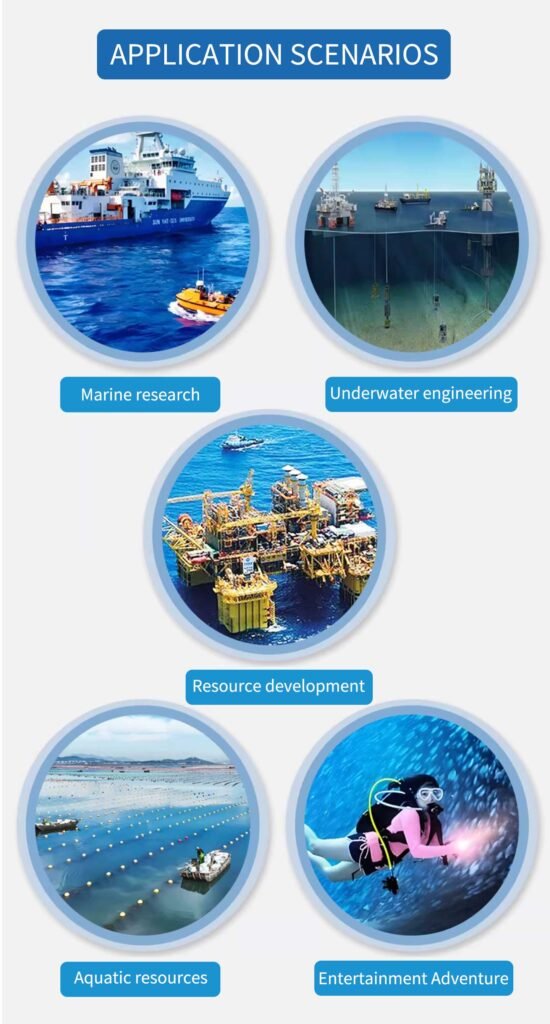
1. Small and Medium-sized Inland River Unmanned Boats
For small and medium-sized unmanned boats used in inland river inspections and water quality monitoring, the power demand is moderate. A power controller with a rated current of 20-40A and capable of supporting 3-6S batteries can be selected, such as the Yu Hai Yun Zhou power controller. Its lightweight design, efficient conversion efficiency, and comprehensive protection features can fully meet the requirements of such scenarios, and the cost is controllable.
2. Offshore Security and Rescue Unmanned Boats
The environment in offshore scenarios is complex, and higher requirements are placed on the waterproof, anti-corrosion, and anti-vibration capabilities of the power controller. It is recommended to choose a power controller with a protection level of IP68 or above and multiple protections, and prioritize support for CAN bus control, which is convenient for integration with complex security and rescue systems.
3. Large-Ocean Unmanned Boats
Large-ocean unmanned boats have high power demands and require a power controller with a rated current of 100A or above and support for high-voltage battery packs. At the same time, the power controller must have efficient heat dissipation and remote monitoring functions, allowing for real-time monitoring of the power controller status to ensure the safety of long-duration operations.
V. Summary of Selection: Focus on the Core, Achieve Precise Adaptation
The selection of brushless power controllers for unmanned vessels focuses on three key principles: “performance matching, environmental adaptation, and safety and reliability”. Firstly, based on the motor power and battery configuration, determine the current and voltage parameters of the power controller; secondly, considering the operation scenario, prioritize choosing models that are waterproof, corrosion-resistant, and shock-resistant; finally, pay attention to control compatibility and protection functions to ensure seamless integration of the power controller with the unmanned vessel system.
Take the Yu Hai Yun Zhou power controller as an example. Its rated current is 30A and peak current is 40A. It supports 3-6S batteries and features efficient conversion, standard PWM control, dual protection, and waterproof design. It perfectly meets the power requirements of small and medium-sized unmanned vessels and is a cost-effective choice for water-based operation scenarios. Precise selection of power controllers not only enhances the power performance and endurance of unmanned vessels but also lays a solid power foundation for their safe and stable operation.